



Multi-omics-based identification of atopic dermatitis target genes and their potential associations with metabolites and miRNAs
Source : https://www.ncbi.nlm.nih.gov/pmc/articles/PMC8748113/
Atopic dermatitis (AD), or atopic eczema, is one of the most common inflammatory skin diseases with up to 10% prevalence in adults, and approximately 15-20% in children in industrialized countries....
Our results revealed potential novel associations between fatty acids and peroxisomal lipid metabolism pathways, as well as with several microRNAs.
-
Atopic Dermatitis Connect4yrKey Points • Source: Journal of Allergy and Clinical Immunology • Conclusions/Relevance: “These results highlight severe infant LRTI [lower respiratory tract infection] as an important risk factor for allergic atopic disease, namely poly-sensitization and Show More
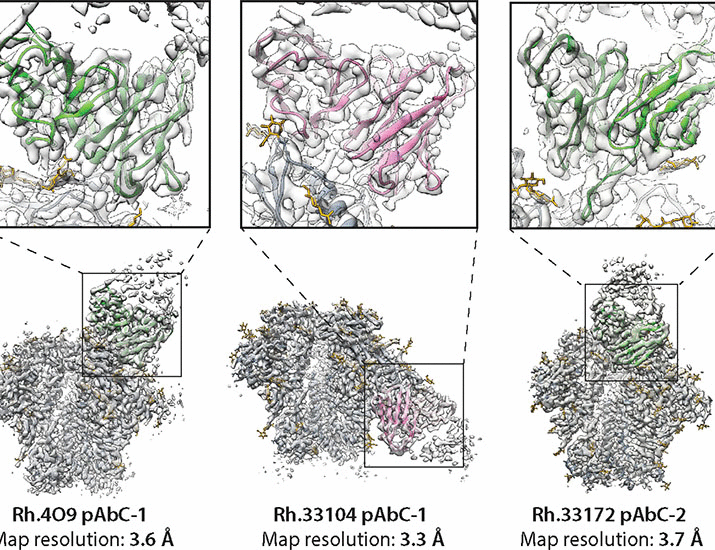
From structure to sequence: Antibody discovery using cryoEM
Source : https://www.science.org/doi/10.1126/sciadv.abk2039
One of the rate-limiting steps in analyzing immune responses to vaccines or infections is the isolation and characterization of monoclonal antibodies. Here, we present a hybrid structural and bioinformatic approach...
When combined with next-generation sequencing of immune repertoires, we were able to specifically identify clonal family members, synthesize the monoclonal antibodies, and confirm that they interact with the antigen in a manner equivalent to the corresponding polyclonal antibodies. This structure-based approach for identification of monoclonal...

VitaminD tolerance activation in dendritic cells
Source : https://www.carrerasresearch.org/en/vitamind-tolerance-activation-in-dendritic-cells_197433
Researchers at the Josep Carreras Leukaemia Research Institute and the Germans Trias i Pujol Hospital discover the epigenetic mechanism by which vitamin D promotes tolerogenic characteristics in dendritic cells, key...
Thus, the researchers manage to demonstrate, for the first time, that the relationship between vitamin D and the generation of the tolerance profile of dendritic cells is due to the modification of epigenetic marks by TET2, through the IL-6- JAK-STAT3, very well-known clinical target.

Microbial dysbiosis in a mouse model of atopic dermatitis mimics shifts in human microbiome and correlates with the key pro‐inflammatory cytokines IL‐4, IL‐33 and TSLP
Source : https://doi.org/10.1111/jdv.17911
This article has been accepted for publication and undergone full peer review but has not been through the copyediting, typesetting, pagination and proofreading process, which may lead to differences between...
Conclusions: In this article we show that i) the model of choice to investigate AD needs to be characterized for the cutaneous microbiota if applicable and ii) the oxazolone-mediated mixed Th1-Th2 immune response triggers microbiota-induced alterations which share similarities to dysbiosis in human AD and represents therefore a suitable model...